
TRANSPARENCY INSTEAD OF PROMISES
What a megawatt actually earned
Seven settled months: January to June and August 2026. July is not included. The figures come from the Belgian batteries in our portfolio, with the market figures for September. What the market gave, what the sites actually earned per megawatt, and what decides the difference.
Get the Flexibility Market Update
The last edition, in four numbers
This is the level of detail you get
What a megawatt earned
€4,868
Settled per installed megawatt in August 2026, across 20 sites. An average, not a forecast for an individual battery.
What the market offered
61 h
Hours in September 2026 when the imbalance price fell below zero. The grid then pays you to take power.
How many sites
20
Belgian sites settled in August 2026, from 21 kW storage rooms to a 3 MW industrial battery.
How we are paid
No fixed fee
We take a share of the result. A month that earns nothing earns us nothing.
Settled · Jan 2026 to Aug 2026
What our portfolio actually earned, month by month
This is the core of the report. Settled revenue per installed megawatt for every month in the period, what a client with one megawatt actually received.
The band behind the line shows how far apart the individual sites were in that month.
August 2026 settled €4,868 per installed MW across 20 sites, against €5,589 in June 2026. The fleet average moves with the portfolio as much as with the market: it ran from €2,159 in January to €4,868 in August while the settled fleet grew from 5 sites to 20. Counting only the twelve sites that settled in every month from May to August, the figure barely moved: €4,434, €4,506 and €4,198 per MW. July is not included in this edition.
The ground rules
Four things to know about every figure we publish
Transparency only counts if the numbers are actually readable. These four rules govern every edition, every case and every figure on this site.
Rule 01
Per installed MW
Every site figure is divided by the battery's power in MW. A bigger battery earns more; that says nothing about how well it is used.
Rule 02
Settled, not estimated
Every euro comes from a closed monthly settlement. Nothing is modelled or annualised. The latest month is paid at 70%, the rest about six months later.
Rule 03
Same sites, same period
Next to the average of all sites, we show the sites that were live for the whole period. A growing portfolio does not raise the result.
Rule 04
What we never publish
No client names, fees, contract prices, tariffs or pool identifiers. Sites are described by sector and installed power.
One thing we are not. FlexHub does not run a trading desk. Bids and trades are placed by the aggregator or operator selected for each site. We select that partner, follow delivery, and check the settlement the client is paid on. The figures we publish are what those settlements say, not what we hope they say.
Revenues are never guaranteed. Results depend on the markets, on the site and on the contract behind it. Nothing in the report is a forecast.
What a battery earned, in practice The settled cases Our commercial terms
What we do for you
We choose the partners around your battery and check what they deliver.
One contact for your battery. We choose the aggregator for your site, follow up delivery every week and check every settlement before you are invoiced. Your installer, supplier and hardware stay as they are.
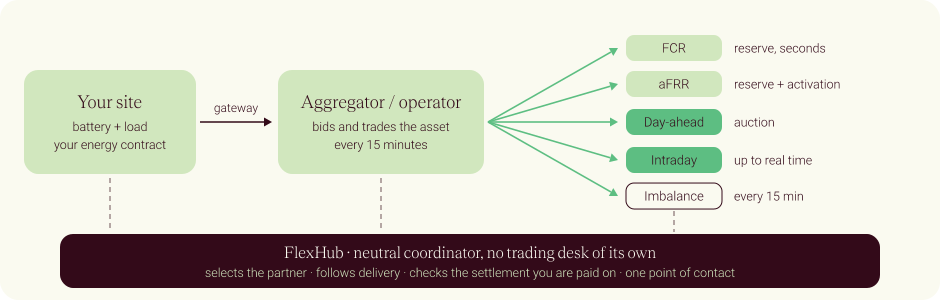
FlexHub does not operate its own trading desk. We act as a neutral coordinator, connecting each customer with the right aggregators, operators and technology providers for their site, and we advise switching flexibility provider when the market turns in your favour.
How we reach each market Which markets paid, last month Settled results, site by site From contract to go-live
Market data · 1 to 29 Sep 2026 · Elia open data
What the Belgian market did in September 2026
What moved in the Belgian market, and what it meant for a battery. Every figure below is the imbalance price: the price at which the grid settles the gap between what was planned and what actually happened, published by Elia for every quarter hour. It is the sharpest public measure of how tight or how long the Belgian system was. The period is 1 to 29 September 2026, 2,784 quarter hours, complete days only.
Hours at a negative price
61 h
244 of the 2,784 quarter hours. The monthly average from January to August 2026 was 66 h, so an ordinary month.
Average imbalance price
€150.02/MWh
The highest monthly average of 2026 so far. January to August ranged from €46.94 to €136.68 per MWh.
Hours above €200/MWh
201.5 h
806 quarter hours, close to four times the monthly average of 51 h from January to August 2026, and nearly double August at 105 h.
Highest quarter hour
€895.37/MWh
Below June at €2,131.18 and below August at €3,121.62 per MWh.
September was the strongest month of 2026 so far for a battery that can react within the quarter hour. Not because of one extreme moment, as the highest quarter hour was lower than in June and August, but because quarter hours above €200 per MWh were about four times as common as usual.
Settled · Aug 2026
The five strongest sites
Settled revenue per installed megawatt, August 2026. Sites are described by size, never by name. One thing stands out this month: reaching an energy market on top of the reserves did not decide the ranking. Three of the five earned everything from reserves alone.
The thing that decides your result
Being ready and being used are two different jobs
If you take one idea away from this report, this is the one. A battery is paid in two quite different ways, and which mix you end up with shapes both your revenue and how long your asset lasts.
Paid for
Standing ready
You commit the battery to be available. You are paid for that commitment whether or not the grid ever calls on it. Steady, predictable income, and the asset barely cycles, so it ages slowly.
Paid for
Being used
The battery actually charges or discharges. Higher earnings in a volatile month, but every activation is a cycle, and cycles are what wear a battery out. Faster income, faster ageing.
The catch
Availability is a promise
Being paid to stand ready means you must actually be ready. An asset that is offline, faulted or constrained when the market calls does not simply earn less; it pays a penalty on what it promised.
What it means
Size is not the story
Two batteries of the same size, on the same markets, in the same period, can land a third apart. The difference is how the asset is deployed and how reliably it delivers, not how many megawatts it has.
One megawatt, line by line
One real site in August 2026, 1 MW · Manufacturing, exactly as it was settled. Selling earns, buying costs, and holding capacity in reserve pays for standing still.
Intraday sell, energy +€7,129
aFRR up, energy +€4,513
aFRR up, capacity +€71
aFRR down, capacity +€30
Intraday buy, energy −€1,109
aFRR down, energy −€3,648
Penalties −€623
To the client €6,363
Client net after the profit share. Buying legs are a real cost, not an accounting entry: a battery that only sold would never have had anything to sell.
How to read this bill
Every line is one revenue source for a single real site in a single month, already at the client's share. Up means the battery injected power into the grid; Down means it absorbed power. Capacity lines are payment for standing ready; energy lines are payment for power actually moved.
The negative lines are the interesting ones. Intraday Buy is the battery purchasing the power it later sells at a higher price: the cost side of a profitable trade, not a loss. aFRR Down · energy is negative for the same reason. And the site still paid a penalty: it promised availability it could not fully deliver. We publish that line rather than netting it away quietly.
Before you sign up
Who this is for, and who it is not for
Worth reading if
You run an industrial or commercial site, you have a battery or you are weighing one, and you want to know what these assets actually return in Belgium rather than what a brochure claims. Installers and consultants read it for the same reason.
Probably not for you if
You are looking for price forecasts or trading advice. This report looks backwards at settled months. It says what happened, not what will.
What happens next
One e-mail a month, with the edition. No sales sequence behind it. If you want your own site looked at, there is a link in every edition, and it stays your move.
Commercial terms
No volume commitment, no exclusivity, a short notice period, and your energy contract stays yours. These are the terms a site signs up on, and they are the reason it can try this without betting the building on it. Read the commercial terms →
Every term we use, defined
This industry hides a lot behind its vocabulary. Nothing in this report uses a word that is not written out here.
Settled revenue
Money from a closed monthly settlement, the document a client is invoiced on. Not a forecast, not a model, not an annualised estimate.
Per installed MW
Revenue divided by the battery's power rating in megawatts. The only way to compare batteries of different sizes fairly.
Power (MW) vs energy (MWh)
Power is how fast a battery can charge or discharge; energy is how much it can hold. A 1 MW / 2 MWh battery delivers 1 MW for two hours. Reserve markets mostly pay for power.
Capacity revenue
Payment for being available: the asset commits to be ready and is paid whether or not it is actually called on.
Energy revenue
Payment for power actually delivered to, or absorbed from, the grid.
Up and Down
Up means injecting power into the grid; Down means absorbing it. A battery is paid for both directions.
FCR
The fastest reserve. The asset reacts within seconds to a frequency deviation, in either direction. Paid for availability.
aFRR
The reserve that takes over after FCR, following an automatic setpoint every four seconds. Paid for availability and per MWh actually delivered.
Day-ahead
An auction held the day before, setting a price for every quarter hour. Known before the day begins.
Intraday
Trading after the day-ahead auction, continuing close to real time, as forecasts and plans change.
Imbalance
Not a market you bid into. Every quarter hour the grid prices the gap between what you scheduled and what you actually did. For a battery it is a settlement mechanism, not a separate income stream.
Imbalance price
The price attached to that gap, published by Elia for every quarter hour of the day. Negative when the system has too much power, high when it is short. We use it as the measure of market conditions, never as revenue.
Negative price
Hours when there is more power on the grid than demand, and a consumer is paid to absorb it. Charging a battery then earns rather than costs.
Spread
The distance between cheap and expensive prices in a period. The room a battery has to buy low and sell high.
Penalty
A charge when an asset promised availability and could not deliver it. Deducted before the result is shared.
Profit share
The agreed split of the net result between the site and FlexHub. No fixed fee sits behind it: if a month earns nothing, the share of nothing is nothing.
Aggregator
The party that places the bids and trades the asset in the markets. FlexHub selects and monitors one for your site; we do not run a trading desk ourselves.
Multi-market vs reserves-only
Whether a site reaches both a reserve market and an energy market, or only reserves. It is the single strongest predictor in this report.
Like-for-like
A comparison restricted to the same sites across every month, so portfolio growth cannot be mistaken for improving performance.
Two batteries of the same size, on the same markets, can earn a third apart. The difference is how the battery is used, not how many megawatts it has.
Antoine Delhaye, Head of Flexibility, FlexHub
What would your site earn?
One e-mail a month with what Belgian batteries actually earned, settled and checkable.
When you want your own site looked at, every edition carries the link, and it stays your move.
Rather see it first? Read the latest edition