
Market Day-ahead (Belpex)
Type: Wholesale energy
Product: 15, 30 and 60 minute blocks, one auction a day
Minimum bid: 0.1 MW
You are paid for: Energy, €/MWh
Four markets and one settlement price, with three ways to earn: selling energy, reserving capacity, and being available.
At a glance
| Market | Type | Product | Minimum bid | You are paid for |
|---|---|---|---|---|
| Day-ahead (Belpex) | Wholesale energy | 15, 30 and 60 minute blocks, one auction a day | 0.1 MW | Energy, €/MWh |
| Intraday (SIDC) | Wholesale energy | 15, 30 and 60 minute products, continuous plus three auctions a day | 0.1 MW | Energy, €/MWh |
| Imbalance | Real-time settlement | 15 minutes, no bidding | None | Your imbalance volume, €/MWh |
| FCR (R1) | Reserve, capacity | Six 4-hour blocks, one auction a day, symmetric | 1 MW | Availability, €/MW/h |
| aFRR (R2) | Reserve, capacity and energy | Six 4-hour blocks plus real-time activation | 1 MW | Availability plus activated energy |
Type: Wholesale energy
Product: 15, 30 and 60 minute blocks, one auction a day
Minimum bid: 0.1 MW
You are paid for: Energy, €/MWh
Type: Wholesale energy
Product: 15, 30 and 60 minute products, continuous plus three auctions a day
Minimum bid: 0.1 MW
You are paid for: Energy, €/MWh
Type: Real-time settlement
Product: 15 minutes, no bidding
Minimum bid: none
You are paid for: Your imbalance volume, €/MWh
Type: Wholesale energy
Product: 15, 30 and 60 minute blocks, one auction a day
Minimum bid: 0.1 MW
You are paid for: Energy, €/MWh
Type: Reserve, capacity and energy
Product: Six 4-hour blocks plus real-time activation
Minimum bid: 1 MW
You are paid for: Availability plus activated energy
One delivery day
Every market has a fixed moment at which bidding stops. That sequence decides how a battery's bids are planned.
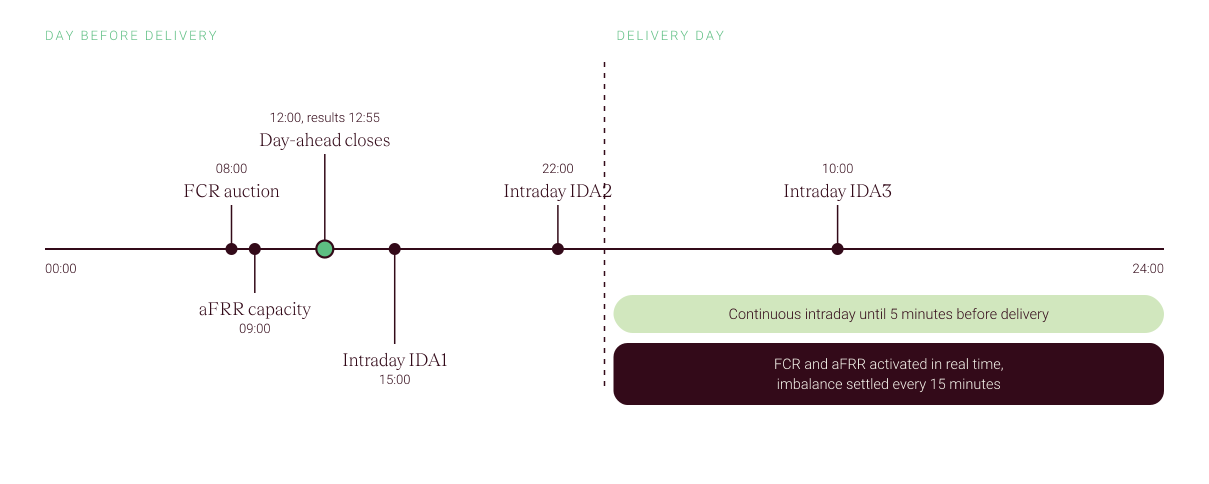
All times CET. Indicative, exact timings follow the Elia and NEMO calendars.
Market by market
Wholesale Energy
An auction on the day before, with a price for every quarter hour. Those prices are known before the day starts, so we plan against them: charge in the cheapest quarter hours, discharge in the most expensive ones.
Closes
12:00 the day before delivery, results from about 12:55
Minimum bid
0.1 MW
Paid for
Energy, at the clearing price every accepted order receives
Belgium 2026
average about €95/MWh, between −€499 and €1,038/MWh
The baseline: charge in the cheap quarter hours, discharge in the expensive ones. The spreads are known a day ahead, so the margins are thinner than intraday.
Wholesale Energy
Trading after the day-ahead auction, right up to close to real time, to adjust the position as forecasts move. Continuous European trading plus three auctions a day.
Closes
Continuous until about 5 minutes before delivery
Minimum bid
0.1 MW
Paid for
Energy. Continuous trading at the price of each match, auctions at the clearing price
Volatility
higher than day-ahead, spreads widen with forecast errors
This is where an optimisation algorithm makes the difference: correcting the day-ahead position and capturing the swings that only appear on the day itself.
Capacity reserve
The fastest reserve. The battery injects or absorbs power within seconds to counter a frequency deviation, symmetrically up and down. Bought jointly by nine European grid operators.
Closes
08:00 the day before, six 4-hour blocks
Minimum bid
1 MW, symmetric
Paid for
Availability only, in €/MW/h. You are paid to stand ready, not for energy delivered
Belgium 2026
Average about €19/MW/h, peaks around €44/MW/h
Requires
Technical prequalification: full response within 30 seconds
A natural fit for a battery: very fast, symmetric and low energy throughput, so steady income with little wear.
Capacity and energy
The reserve that restores the frequency after FCR. The grid operator sends an automatic setpoint every four seconds, cleared on the European PICASSO platform, which Belgium joined in November 2024.
Closes
09:00 the day before for capacity, energy activated in real time
Minimum bid
1 MW
Paid for
Availability and, on top, every activation
Belgium 2026
Capacity about €16/MW/h up and €11/MW/h down, activation energy about €93/MWh
Requires
Full prequalification and a baseline test, the most demanding of the reserves
Currently the strongest revenue market for Belgian batteries, because you earn twice: for being available and for every activation.
Settlement
Not a market you bid into. Every 15 minutes the grid operator applies one imbalance price to the gap between what a party scheduled and what it actually did. A battery can deliberately take a position that helps the system and be paid that price.
Resolution
15 minute settlement period, no nomination
Paid for
Your imbalance volume times the imbalance price
Price rule
One price for shortage and surplus, plus a component that penalises worsening a stressed system
Belgium 2026
Median about €95/MWh, with real extremes from −€15,000 to €2,149/MWh
Requires
Balancing responsibility, no prequalification
The highest reward and the highest risk in the stack. Only worth it under close supervision.
Sources: Elia for the reserves and the imbalance price method, EPEX SPOT for day-ahead and intraday products, ENTSO-E network codes, FCR Cooperation and PICASSO. Price ranges are from the 2026 Belgian dataset behind our monthly reports.
WHERE THIS IS GOING
Batteries earned most on FCR and aFRR. That payment falls as more batteries enter those reserves, while solar and wind make day-ahead and intraday prices more volatile. So the strategy covers both.
✓ Several markets at once, not one
✓ Neutral coordination, no trading desk of our own
✓ Aligned with your energy contract