

Alexandre Indekeu
MANAGING DIRECTOR
We have no trading desk and no hardware to sell. We earn a share of what your battery earns, nothing more.
The Flexibility Market Update
How the Belgian energy market moved from January to September 2026, which strategies our batteries follow, and which five sites earned the most in August.
Market data Jan to Sep 2026 · Settled sites Aug 2026 · Belgium
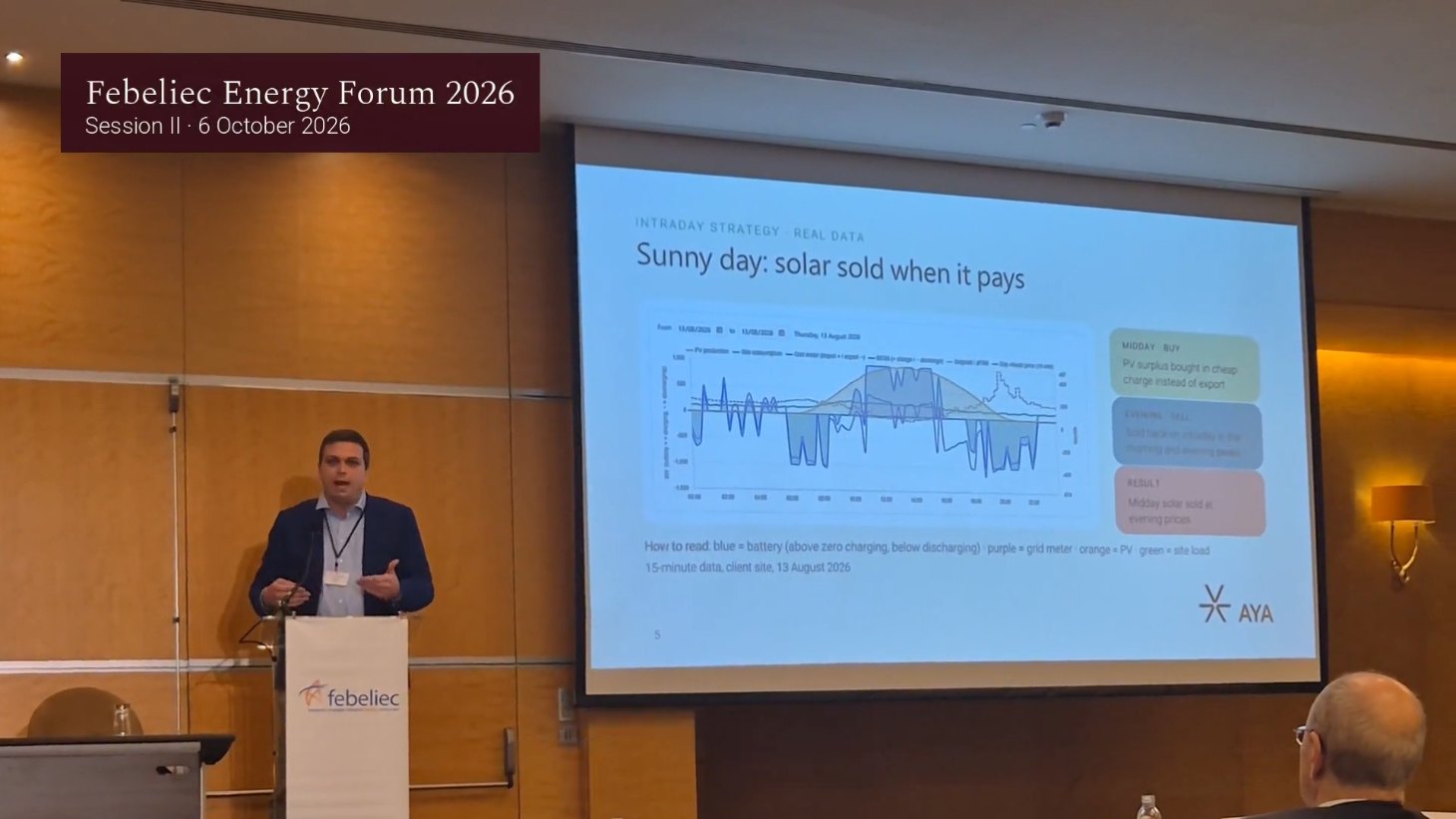
Our Head of Flexibility, from the Febeliec Energy Forum session, 6 October 2026
live in the markets
assets live
in onboarding
What the market offered
Hours in September 2026 during which the imbalance price fell below zero. In such cases, the grid pays a battery to charge it.
You already have a battery. We compare what it earns today with what it could earn, on your own metering data and your own energy contract.
The people behind the figures




Two kinds of income, and which one the euro figures count
In front of the meter (FTM): the battery works for the grid. The income is paid out by the markets: reserve capacity (FCR and aFRR) and energy trading (intraday). It is settled every month. The euro per megawatt figures of the five strongest sites are this kind of income.
Behind the meter (BTM): the battery works for your own site. The value is a saving on your own energy bill, for example by keeping your own solar power for the evening instead of injecting it, or by buying less from the grid in expensive hours. No market pays it out, so it is not in the euro per megawatt figures.
The same battery can do both.
Market data · Jan to Sep 2026 · Belgium
Nine months of market prices, so September can be read against the months before it. These are market conditions, not what any site earned.
The price at which the grid settles the gap between what was planned and what actually happened, per quarter hour. This is where a battery offers its capacity to the grid.
Hours at a negative price
Grid pays to take power. Jan to Aug average: 66 h. An ordinary month.
Elia open data, ods134
Average imbalance price
All quarter hours of the month. Highest monthly average of 2026. Jan to Aug average: €100,14.
Elia open data, ods134
Hours above €200/MWh
Quarter hours worth reacting to. Jan to Aug average: 51 h. Four times as many in September.
Elia open data, ods134
Highest quarter hour
The single most expensive 15 minutes. Below June (€2.131,18) and August (€3.121,62).
Elia open data, ods134
The price set the day before for every quarter hour of the next day. A supply contract indexed to it follows it, so it is the price a battery meets when it works for its own site.
Average day-ahead price
What a site on a dynamic contract pays. Highest monthly average of 2026. Jan to Aug average: €100,96.
EPEX Spot day-ahead, via energy-charts.info
Evening minus midday
17:00 to 21:00 against 11:00 to 16:00. Largest gap of 2026. Jan to Aug average: €84,08.
EPEX Spot day-ahead, via energy-charts.info
Average daily spread
Highest minus lowest quarter hour of each day. Only June was higher (€251,06).
EPEX Spot day-ahead, via energy-charts.info
Hours above €200/MWh
Day-ahead, expensive to buy from the grid. Jan to Aug average: 16,5 h. About eleven times as many.
EPEX Spot day-ahead, via energy-charts.info
September was the strongest month of 2026 so far on both sides of the meter. Not because of one extreme moment, but because expensive quarter hours were far more common than usual: 205 hours above €200 per MWh on the imbalance price, against a monthly average of 51 hours.
Portfolio · Oct 2026
Our batteries do not all do the same thing. The portfolio runs four strategies. Most combine the optimisation behind the meter of the site itself with one or more grid markets; one runs purely on the short-term markets. Per strategy we publish one number: the installed megawatts running it.
The building blocks: Site, the site's own energy, behind the meter · Reserve, standing ready for the grid · Balancing, called on to balance the grid · Short-term trading, energy traded close to real time.
Strategy 001 · [MW] MW
Site + Reserve
The battery serves the site, and the capacity it does not need stands ready for the grid.
Strategy 004 · [MW] MW
Site + Balancing
The battery serves the site, and helps keep the grid in balance when it is called on.
Strategy 006 · [MW] MW
Site + Short-term trading
The battery serves the site, and trades its spare energy close to real time.
Strategy 007 · [MW] MW
Short-term trading
No site to serve: the whole battery works on the short-term markets.
Why we publish the megawatts and keep the recipe
Every battery runs one strategy and can switch when the market changes. We show how many megawatts run each strategy. Which markets sit behind each block, and how much of each, we keep to ourselves: that is part of what we deliver.
One battery, one day
A battery does not do one job all day. At night it stands ready for the grid. From mid-morning it stores the site's own solar power. In the evening the site uses that energy instead of buying it. Whatever capacity the site does not need goes to the market.
The connection limits, the energy contract and the priorities of the site are fixed. The split is made inside them.
The site and several markets in the same day, instead of one use for the whole battery.
The strategy a battery runs decides how the pieces are laid: more for the site, more for the grid, or all for the short-term markets.
What we do for you
FlexHub is your single point of contact that structures, unlocks and continuously optimises your flexibility assets. We do not replace your installer, your supplier or your technology. We bring the right parties together around your site and keep the whole set working in your favour.
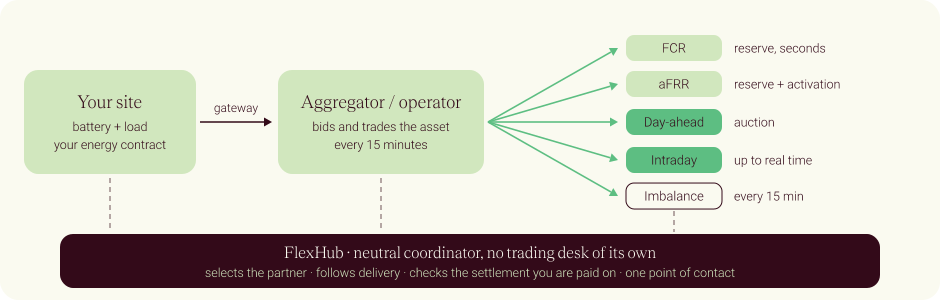
FlexHub does not operate its own trading desk. We act as a neutral coordinator, connecting each customer with the right aggregators, operators and technology providers for their site, and we advise switching flexibility provider when the market turns in your favour.
How to read the site figures
Every site figure is shown per megawatt of battery power, so small and large batteries can be compared. Every euro comes from the monthly settlements. We never publish client names, fees or contract prices.
Settled · Aug 2026
Settled revenue per installed megawatt, Aug 2026. Sites are described by size, never by name. One thing stands out this month: reaching an energy market on top of the reserves did not decide the ranking. Three of the five earned everything from reserves alone.
The thing that decides your result
A battery is paid in two different ways. The mix decides both your revenue and how long the asset lasts.
Paid for
You commit the battery to be available. You are paid for that commitment whether or not the grid ever calls on it. Steady, predictable income, and the asset barely cycles, so it ages slowly.
Paid for
The battery actually charges or discharges. Higher earnings in a volatile month, but every activation is a cycle, and cycles are what wear a battery out. Faster income, faster ageing.
The catch
Being paid to stand ready means you must actually be ready. An asset that is offline, faulted or constrained when the market calls does not simply earn less; it pays a penalty on what it promised.
What it means
Two batteries of the same size, on the same markets, in the same period, can land a third apart. The difference is how the asset is deployed and how reliably it delivers, not how many megawatts it has.
Commercial terms
No volume commitment, no exclusivity, a short notice period and your energy contract stays yours. These are the terms a site signs up on, and they are the reason it can try this without betting the building on it. Read the commercial terms on flexhub.energy →
SOURCES · In front of the meter: Belgian imbalance prices, Elia open data, dataset ods134, per quarter hour, months in Belgian time. Behind the meter: Belgian day-ahead prices, EPEX Spot, quarter-hour resolution, via energy-charts.info (Fraunhofer ISE), data Bundesnetzagentur | SMARD.de, licence CC BY 4.0. Five strongest sites: monthly settlement August 2026.
REVENUES ARE NEVER GUARANTEED · Results depend on the markets, the site and the contract behind it. Nothing here is a forecast.